


Travellogue: On the way to Bhandardara
Mumma’s friend had her son’s wedding organised in Kalyan, and had invited her college friends from almost another corner of the state that is from Vidarbha. Nashik came in the way and so my mother was overwhelmed to host her college friends and meet them after around 25-30 years. Whole house was in hustle and bustle to welcome them, until the visiting day arrived. Her friends had decided to visit us first and then head towards their marked destination. As we had one day to spare, we decided to take them to the Bhandardara Dam, a reservoir on the Nashik- Ahmednagar border and its backwaters which included many worth visiting tourist spots. We were privileged to find an awesome driver uncle, who didn’t hesitate to fulfill any of our demands. I had visited the place a lot many times before but this time was an unique experience. As we all know what matters is journey over the destination, on the way this time I and he were witness to the continuous chatter of old friends meeting after almost 3 decades reminiscing all their old memories of college. One of the aunts were a lot fond of flowers and their plants and wished to take them home. Being the month of November, which is known for the end of fall (autumn) and the beginning of pre-winter generally harbours variety of wild flowers. Purple Asters, yellow-orange Cosmos dancing with the winds takes over the surroundings, rabi crops just being sown in the fields, small green grass blades everywhere, sky is clear with some untimely showers. Coming back to the topic, the dendrophilist more specific to say anthophilist aunt, after looking around the road made driver uncle to stop the car every time and went to pick up the propogative parts of the plants so that she could grow it in her house garden. By the end of the day we had collected almost 20-30 new varieties of roadside wild plants. Mom and the other aunt had one more story of hers to tell, about they used to have fun in college times helping her collect the flower plants from the surrounding environment. Afterwards in our journey she bought many gargotis (stones and pebbles with different structures, patterns and colours) being sold by an old man. Deccan plateau being rich in igneous rocks has many such stones, which is set up as a Gargoti museum in Sinnar, near Nashik. Seeing all this I got to learn from the aunt how one should take care of their own likes and hobbies and be passionate and crazy enough to live it to its fullest capacity. Moreover got knowledge about many different varieties of ornamental plants we never even pay attention to. We reached the village called Shendi, from where the actual trip would commence. The trip around the backwaters from oneside is all about differently named waterfalls like neclace falls, umbrella falls, naneghat falls, etc. that grows brighter in rainy seasons and from other side is about the water around the mountain scenery and the way to Kalsubai, highest peak of Sahyadris (Western Ghats) in Maharashtra. There are number of spots on the circular way around the back waters. Arthur Lake was the first spot that we came across. It reminded me of the location where Rancho flies the toy aeroplane with his students towards the end of the movie ‘3 idiots’. The place was picturesque in such a serene atmosphere with the clear sky and pure water. Next spot needed a tourist guide for better experience. We wished to watch it all by ourselves, but at last, one guy convinced us about his importance. He was very talkative guy named Kalubaba. He himself was almost in his 60s, but addressed the ladies with me to be grandmas in humorous way. It was a great challenge for them to prove him wrong. He marched us towards the reverse waterfall. Its actual season is rainy when its actual merriment could be experienced. As it was winter, we were late for the amazement but there were other gifts offered by the pre-winters that caught our attention. One of them were the magnificent large black mountain ranges and the sun’s shadow being cast over them bringing different visual effects of golden black design over the edges. They were called as Kokankada told our guide. Also on the plateau of the reverse waterfall there was a blanket spread of the cute purple flowers just like lavenders reminded me of the ‘Daffodils’ poem by great poet William Wordsworth “Ten Thousand saw I at a glance.” As we walked past the flowers there was a forest of bush palm or black currant called as ‘ करवंद ‘ (karvanda) in marathi and ‘काळी मैना’ (kali maina) in local languages. Our guide specifically mentioned that the place is filled with different birds and chirping sounds in the months of April, May during its fruiting season. There was a fort seen on the mountainous side along the forest. Its name was Ratangad after Ratnabai Tandal which was captured by Shivaji Maharaj in his times. Our guide also had some legend to tell about it. He told that we should have come early in the morning to trek up to the fort because it takes around 4-5 hrs to climb the mountain. While heading to our next spot, we came across some holes on the grasslands. When asked the guide, we came to know that these tribal villagers eat the crabs dwelling in those holes. He described many local crab species and delicacies made from them and that the soup made from the black crabs had medicinal utility. Also he told us about how the leopards come in the villages nearby to visit. And that the main crop in the region is rice and the forest produce. Livelihood of the people is met through the tourism service and the paddy produce mainly.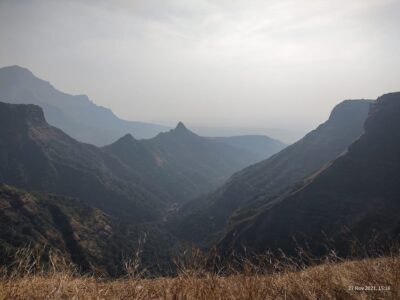 Our next spot was the actual attraction, we had planned the whole trip for. It was the Sandhan Valley also known as the ‘Valley of Shadows’. It is a gorge or a canyon cut down by the ferocious water streams coming down from the surrounding mountains over 1000s of years. It runs for almost 2 km. It is one of the adventurous trek and also an outstanding feature of Sahyadris. Our guide first shown us the valley from above. The way to enter the valley was either through rapelling (to climb down the steep walls with the help of ropes) or walking through the stream route along with small big pebbles and huge stones that made their way in the valley either through erosion or land slides.
The soothing touch of the cold speedy water of the stream, made me feel like sitting there with the feet inside for as long as possible. When we drank the water of the small waterfalls to quench our thirst, our tour guide asked us, “Isn’t this water sweeter, cleaner and tastier than the one of your ROs at home? This is what is nature’s true love.” Here is where he proved that such an adventurous trip was very tough for middle aged people and especially the women who tend to remain reluctant to adventure, and so he had addressed mom and her friends as grandmas before. I and driver uncle made up until the middle of the valley. Beyond a limit there was water filled, still many men were daring to enter. But by the time we reached back the starting point, the sun had almost begun to set and we had 2 more spots to visit.
Next spot was the Amruteswar Temple, Ratanwadi village situated at the foot of the Ratangad fort. It was a very old Shiva Temple built in 9th century. We had visited it earlier once in the rainy season and the sanctum was filled with water completely submerging the shiv lingam inside. The temple showcases the architectural skills of the then artists seen through the intricate designs on the pillars and walls of the temple. But as tour guide said it was going to take more of our time with rough road and we didn’t wish to miss the sunset at the dam, so we decided to skip the spot. We bid adieu to our amazing guide for the day, who shared with us his life stories and incredible practical knowledge of experience, that can’t be gained reading in just books.
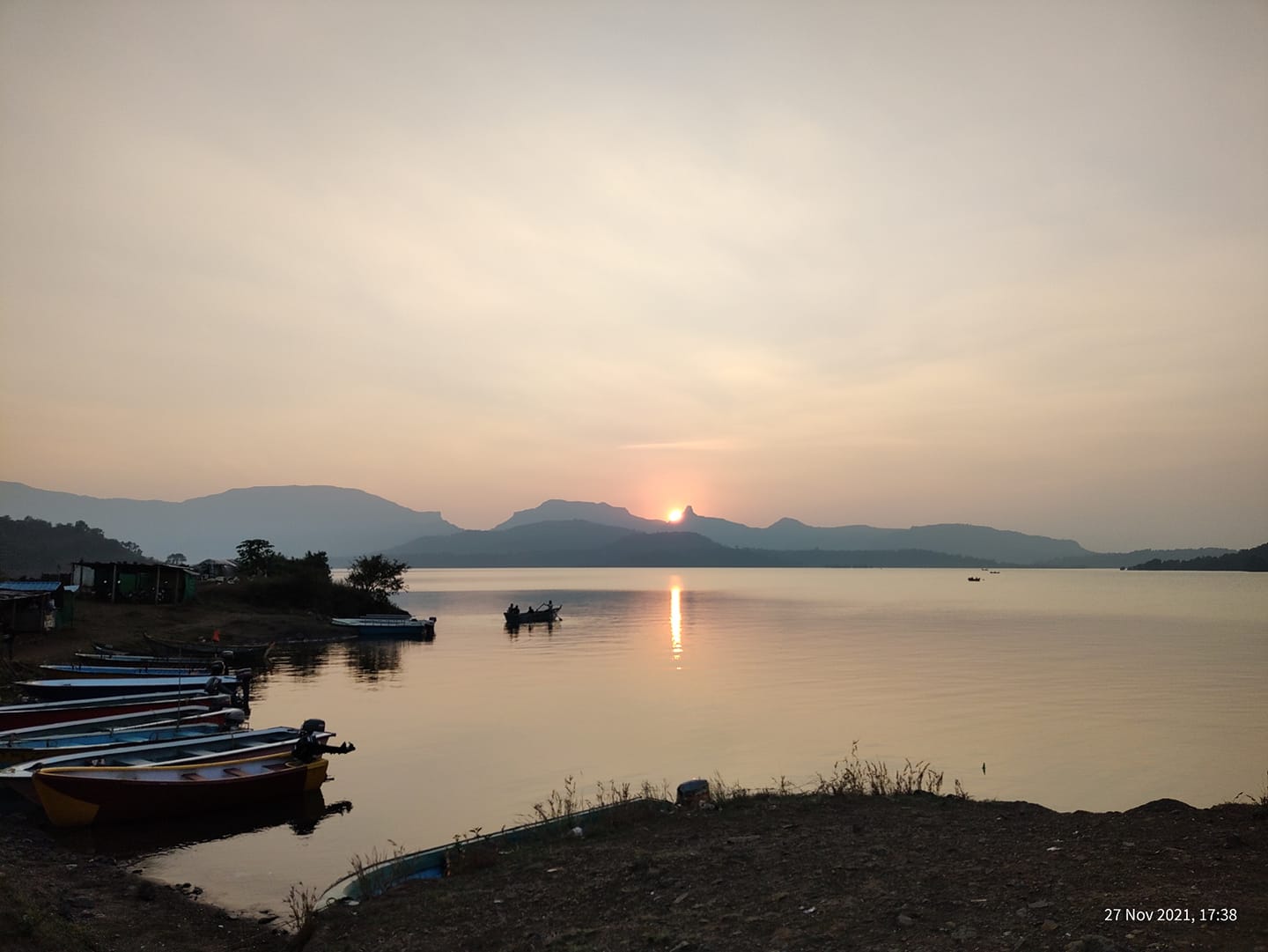
The last spot of the day was the Bhandardara backwaters surrounded by the mountain ranges. And we reached the spot coincidentally exact when the sun had started touching the edges of the mountains to take our leave for the day. As usual and as described by many authors and poets the mesmerizing moment of sun going beyond the horizon and the condition of the sky in the background kept us awe-stricken for sometime. After the moment was over, we decided to sail in a boat and with the winds blowing over the water, and the reflection of the dusky warm strokes in the sky got to experience the unfathomable calmness (could hear my own heartbeats) and enigmatic peace (contemplation) that refreshed and recharged me for the time ahead. Both the aunts came out finding and discussing about the songs of their times that would fit such a scenery like
‘माझी चल ओ माझी चल…’, ‘नाविका रे वारा वाहे रे…’, ‘ओ माझी रे, अपना किनारा…’, etc.
Our next spot was the actual attraction, we had planned the whole trip for. It was the Sandhan Valley also known as the ‘Valley of Shadows’. It is a gorge or a canyon cut down by the ferocious water streams coming down from the surrounding mountains over 1000s of years. It runs for almost 2 km. It is one of the adventurous trek and also an outstanding feature of Sahyadris. Our guide first shown us the valley from above. The way to enter the valley was either through rapelling (to climb down the steep walls with the help of ropes) or walking through the stream route along with small big pebbles and huge stones that made their way in the valley either through erosion or land slides.
The soothing touch of the cold speedy water of the stream, made me feel like sitting there with the feet inside for as long as possible. When we drank the water of the small waterfalls to quench our thirst, our tour guide asked us, “Isn’t this water sweeter, cleaner and tastier than the one of your ROs at home? This is what is nature’s true love.” Here is where he proved that such an adventurous trip was very tough for middle aged people and especially the women who tend to remain reluctant to adventure, and so he had addressed mom and her friends as grandmas before. I and driver uncle made up until the middle of the valley. Beyond a limit there was water filled, still many men were daring to enter. But by the time we reached back the starting point, the sun had almost begun to set and we had 2 more spots to visit.
Next spot was the Amruteswar Temple, Ratanwadi village situated at the foot of the Ratangad fort. It was a very old Shiva Temple built in 9th century. We had visited it earlier once in the rainy season and the sanctum was filled with water completely submerging the shiv lingam inside. The temple showcases the architectural skills of the then artists seen through the intricate designs on the pillars and walls of the temple. But as tour guide said it was going to take more of our time with rough road and we didn’t wish to miss the sunset at the dam, so we decided to skip the spot. We bid adieu to our amazing guide for the day, who shared with us his life stories and incredible practical knowledge of experience, that can’t be gained reading in just books.
The last spot of the day was the Bhandardara backwaters surrounded by the mountain ranges. And we reached the spot coincidentally exact when the sun had started touching the edges of the mountains to take our leave for the day. As usual and as described by many authors and poets the mesmerizing moment of sun going beyond the horizon and the condition of the sky in the background kept us awe-stricken for sometime. After the moment was over, we decided to sail in a boat and with the winds blowing over the water, and the reflection of the dusky warm strokes in the sky got to experience the unfathomable calmness (could hear my own heartbeats) and enigmatic peace (contemplation) that refreshed and recharged me for the time ahead. Both the aunts came out finding and discussing about the songs of their times that would fit such a scenery like
‘माझी चल ओ माझी चल…’, ‘नाविका रे वारा वाहे रे…’, ‘ओ माझी रे, अपना किनारा…’, etc.
 As the night began to cast its dark veil over the sky, we had left the region with some awesome memories and fascinating day of experiences. We had in our collection many different seeds and plants our aunt had collected, photos and memories created, new knowledge and experiences gained from the new introductions with new people. And to conclude we decided that we should organize such enriching and refreshing trips more often. Mummy’s friends called the trip a worthwhile one, satisfying one and enjoyed a lot getting freed from the everyday routine chores.
In this trip, I tried catching lot of scenes in the photographs, but the camera however clear and high resolution it may be will always remain incompetent to capture the true charm of the live scenery. I realised that power of senses is so limited but the beauty of the moments were limitless and hence impossible to store. I feel this beauty will prevail until the nature is left in its crude original form, the way we found it here. Once the tourism business exceeds its limits and everything starts getting developed and commercialized and the exploitation of nature and tribals there begins, this beautiful abode of peace will turn into tourist spots just like Matheran or Mahabaleshwar. We must try and prevent this from happening not only for tribal and nature but for us so that such rejuvenation spots don’t become extinct and protect them in their original forms without imposing on them any type of artificial covers that we have covered ourselves with under the name of development.
As the night began to cast its dark veil over the sky, we had left the region with some awesome memories and fascinating day of experiences. We had in our collection many different seeds and plants our aunt had collected, photos and memories created, new knowledge and experiences gained from the new introductions with new people. And to conclude we decided that we should organize such enriching and refreshing trips more often. Mummy’s friends called the trip a worthwhile one, satisfying one and enjoyed a lot getting freed from the everyday routine chores.
In this trip, I tried catching lot of scenes in the photographs, but the camera however clear and high resolution it may be will always remain incompetent to capture the true charm of the live scenery. I realised that power of senses is so limited but the beauty of the moments were limitless and hence impossible to store. I feel this beauty will prevail until the nature is left in its crude original form, the way we found it here. Once the tourism business exceeds its limits and everything starts getting developed and commercialized and the exploitation of nature and tribals there begins, this beautiful abode of peace will turn into tourist spots just like Matheran or Mahabaleshwar. We must try and prevent this from happening not only for tribal and nature but for us so that such rejuvenation spots don’t become extinct and protect them in their original forms without imposing on them any type of artificial covers that we have covered ourselves with under the name of development.
+1

Beautiful writing Aditi
Amezing experience dipicted,Aditi
Thank u, both of u and for all the views n honest replies on all the other platforms , it has surely encouraged me to move forward… 😊🙏🙏🙏